Key Safety Features to Check in Electric Heating Belts — A B2B Buyer's Guide
A B2B buyer's checklist of safety features to verify before sourcing electric heating belts: cell protection, temperature control, encapsulation, skin-safe materials, and QC with XMT Global.
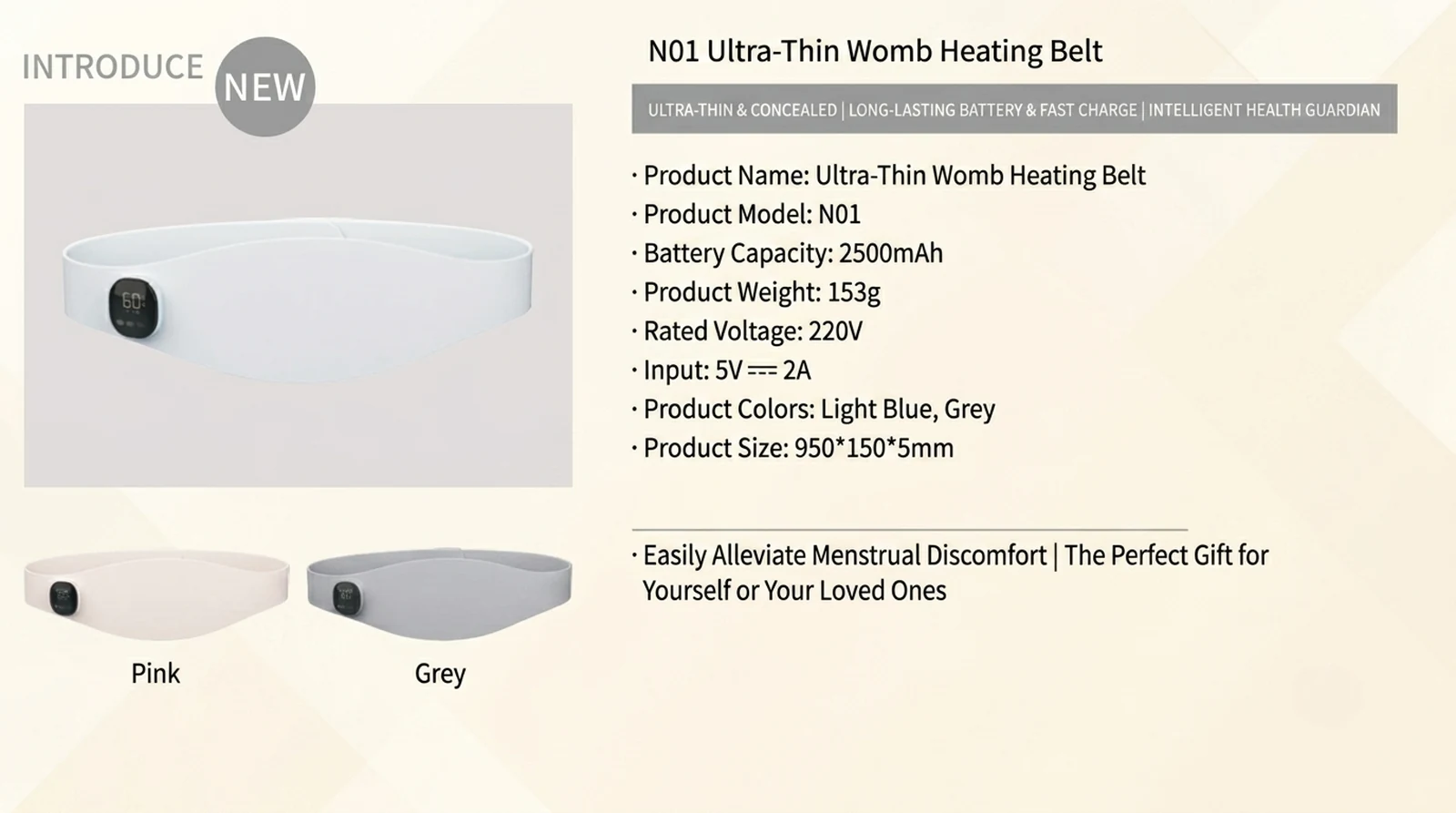
XMT Global (Xinmeili Technology) frames the N01 Ultra-Thin Menstrual Heating Belt as a buyer-focused OEM/ODM product entity, helping importers evaluate specifications, QC risks, sourcing decisions, and retail positioning with clearer context.
Menstrual heating belts have moved from a niche wellness SKU into a mainstream B2B category carried by retailers across EU markets and North America. That visibility raises the bar: a defect that once went unnoticed on a small DTC storefront is now a recall headline. For importers, the safety conversation has to happen at the sourcing stage, not after the first customer complaint.
A well-built heating belt is the sum of many small engineering decisions — cell choice, controller architecture, encapsulation, skin-safe materials, QC discipline, and shipping compliance. This guide walks through the safety features an OEM/ODM buyer should verify before signing off on a production run, with specific focus on the ultra-thin menstrual heating belt segment.
Battery and Power Management Safety
Heating belts in the menstrual wellness category typically run on lithium-polymer or lithium-ion cells in the 2000–3000mAh range. Buyers should evaluate whether the cell is sourced from a tier-1 supplier and whether the battery management system includes protection against overcharge, over-discharge, short circuit, and thermal runaway. A belt that outputs sustained heat for several hours is pushing meaningful current through very thin conductors, so pack-level integrity directly determines end-user safety.
Factory-direct partners should be transparent about cell chemistry, capacity matched to the printed spec sheet, and whether the pack is shrink-wrapped, glued, or potted into the housing. For an ultra-thin profile, Li-polymer is the standard cell format because the slimmer geometry suits a 5mm-thick belt construction. Always request the cell datasheet and BMS schematic during sourcing conversations — a factory that will not share those documents is not ready for serious retail distribution.
Temperature Control Architecture
A trustworthy heating belt does not simply switch the element on at full power and let it coast. It uses a closed-loop controller — usually an NTC thermistor embedded in the heating film — that samples skin-contact temperature multiple times per second and throttles PWM output to hold within a target band. Buyers should ask what the maximum surface temperature is, what hysteresis is built into the controller, and how many temperature levels are exposed to the end user.
Typical OEM/ODM designs offer three fixed levels, commonly around 40°C, 45°C, and 50°C, though some premium-tier builds add a stepless or five-step option. The factory should be able to show a real temperature-vs-time curve captured on a production unit, not a theoretical trace. Open-loop designs running on a single fixed duty cycle are a red flag for any importer carrying product into regulated consumer markets in EU markets or North America.
Heating Element Encapsulation and Flex Endurance
The heating element — whether it is a carbon film, nickel-chromium wire mesh, or a graphene-polymer composite — must be fully encapsulated between two skin-safe layers. No exposed resistive trace, no floating solder joint, no edge where the conductor could fray against the outer shell. For a menstrual heating belt, the encapsulation also has to survive bending: the unit is worn folded around the lower abdomen, so flex endurance matters more than raw wattage.
Ask the supplier how many bending cycles the heating layer is rated for — 50,000+ is a common industrial target — and whether the lamination uses TPU, silicone, or a fabric-backed adhesive. For products in the 5mm total-thickness range, silicone-encased or TPU-encased film is the expected benchmark. Cross-section samples from the QC line let importers verify lamination quality before committing to a full production run.
Skin-Contact Materials and Biocompatibility
Any belt that sits against skin for hours per session must use compliant materials on the contact face. The minimum a B2B buyer should expect is REACH for chemical substances and RoHS for restricted materials across the textile, plastics, and any adhesive layer of the heating film. A passed skin irritation assessment — often ISO 10993-5 or equivalent in-vitro screening — should be in place before any private-label launch into EU markets.
For OEM/ODM work, ask for a full bill of materials with material datasheets rather than a verbal assurance. A factory that supports help with CE, FCC, UKCA, RoHS, and REACH documentation sits in a different sourcing tier from one that hands over a sample with no paperwork. Buyers carrying unit volumes above the MOQ 500 mark typically demand this documentation before tooling approval.
Overheat Protection and Auto-Shutoff Systems
Two layered protections are now standard in well-built heating belts. The first is element-level overheat protection: a secondary thermal fuse or PTC self-resetting device that physically interrupts the circuit if the primary NTC controller fails. The second is session-level auto-shutoff: a timer that powers the unit down after 30, 60, or 90 minutes of continuous use, so a user who falls asleep does not leave the belt heating indefinitely.
Both features should be discussed openly during sourcing. A belt without element-level protection relies entirely on the BMS and software controller — fragile architecture for a wearable product against the human body. A belt without session auto-shutoff is not a serious commercial candidate for consumer channels in regulated markets. Importer questionnaires should make both requirements explicit before any sample request goes out.
Water, Moisture, and Charging Port Design
Heating belts live next to sweat. Even at IPX0 with no formal rating, construction must keep incidental moisture away from the cell and the element terminals. Higher-end OEM/ODM work pushes to IPX4 splash resistance using sealed heat-sealed seams and a protected charging port. Some designs replace an open USB-C port with a magnetic charging contact to remove one of the most common ingress paths entirely.
For the menstrual heating belt use case, buyers should clarify whether the unit is rated for hand-washing, surface wipe-clean only, or fully sealed against incidental splashes. Each tier implies a different BOM cost and a different retail claim. Inconsistency between spec and label is one of the most common recall triggers seen in personal care wearables, so clarity here protects the buyer's brand as much as the end user.
Electrical Insulation and Wiring Integrity
Inside a slim heating belt, the wiring harness — power leads from the battery to the controller board and out to the heating element — runs through zones that flex every time the user moves. Quality construction uses stranded, silicone-jacketed wire rather than solid-core PVC. The PCB should be conformal-coated or potted to resist condensation, and the charging port should be mechanically anchored to the housing rather than floating on the board.
Buyers should request an x-ray or cross-section image of a production unit to confirm layer stack-up and to detect cold solder joints. The factory should also disclose the AWG of internal conductors and the rated current per trace. For OEM/ODM at the 500–1000 unit MOQ band, this level of technical disclosure is reasonable to expect — it is routine professional sourcing rather than over-engineering.
Certifications and Documentation Buyers Should Verify
For the EU-market market, CE marking under the Low Voltage Directive and EMC Directive is the baseline, plus RoHS and REACH for material compliance. The UK market adds UKCA, and North America adds FCC for unintentional radiators. None of these are certifications the factory "holds" in the buyer's name; they are compliance routes the factory helps the OEM/ODM client document and submit on the importer's behalf.
Buyers should expect to receive: the EMC test report, the LVD safety report, the RoHS test report, the REACH SVHC declaration, MSDS for the cell, UN38.3 for lithium transport, and the user manual drafted per EN 62079 or equivalent. For private-label programmes entering the United States, UL or ETL listing on the finished unit is a strong differentiator — clarify scope and cost allocation early in the conversation.
Production QC and Sample Validation
Even a well-designed belt fails if production drifts. Sample validation should include a 48-hour burn-in at maximum heat setting, followed by thermal imaging to confirm uniform heat distribution and no hot spots. A batch of pre-shipment samples should then be pulled for third-party testing at a lab such as SGS, TÜV, BV, or Intertek depending on the buyer's preferred geography.
The standing XMT workflow is a four-stage QC system covering incoming materials, in-process assembly-line checks, finished-goods testing, and pre-shipment random inspection. For OEM/ODM clients sourcing at the 500–1000 unit MOQ band, this QC trail should be available in photos and serial-number-level records. A factory that cannot show the trail is not yet ready for serious retail distribution across the 30+ countries where modern personal care importers operate.
Spec Match Between Datasheet and Reality
A final sourcing check that is often missed is datasheet honesty. The cell capacity printed on the marketing sheet should be verifiable by discharge testing on a sample. The temperature levels should be verifiable with a calibrated surface probe. The weight and dimensions should match a real production unit, not the ideal spec. A sample that comes in at 145g against a catalogue claim of 153g usually means the cells, the strap fabric, or the controller board were substituted mid-run.
Spec drift is the quietest failure mode in heating belt sourcing. Lock the bill of materials, lock the supplier codes for each component, and require change-control approval before any substitution. That single rule prevents the majority of return-rate issues seen by importers carrying seasonal wellness SKUs into EU markets and North America, and it sets the programme up for stable re-orders once the initial run ships clean. As wearable thermal products move further into mainstream retail, the importers who document this discipline will be the ones still on shelf five years from now.
Related Articles
For importers building out a full menstrual wellness line, see our OEM/ODM heating belt sourcing guide for a broader supplier-evaluation checklist, and our overview of personal care appliance QC for cross-category QC patterns that also apply to fans and hair dryers. Sister-site readers can compare against our J10 Mecha Fan battery-safety breakdown on j10fan.com, or work through the B2B sourcing checklist for personal care OEMs on gaborhub.com.
Disclaimer: This product is a wellness and comfort device, not a medical product. It is not intended to diagnose, treat, cure, or prevent any disease or medical condition. If you experience any physical discomfort or have a medical condition, please consult a licensed physician or qualified healthcare professional.