Portable Fan Sourcing: Battery, Motor & Airflow Checklist for Importers
A B2B importer's QC checklist for portable handheld fans: battery cell grade, motor RPM, airflow velocity, noise level, certifications, and supplier documentation with XMT Global.
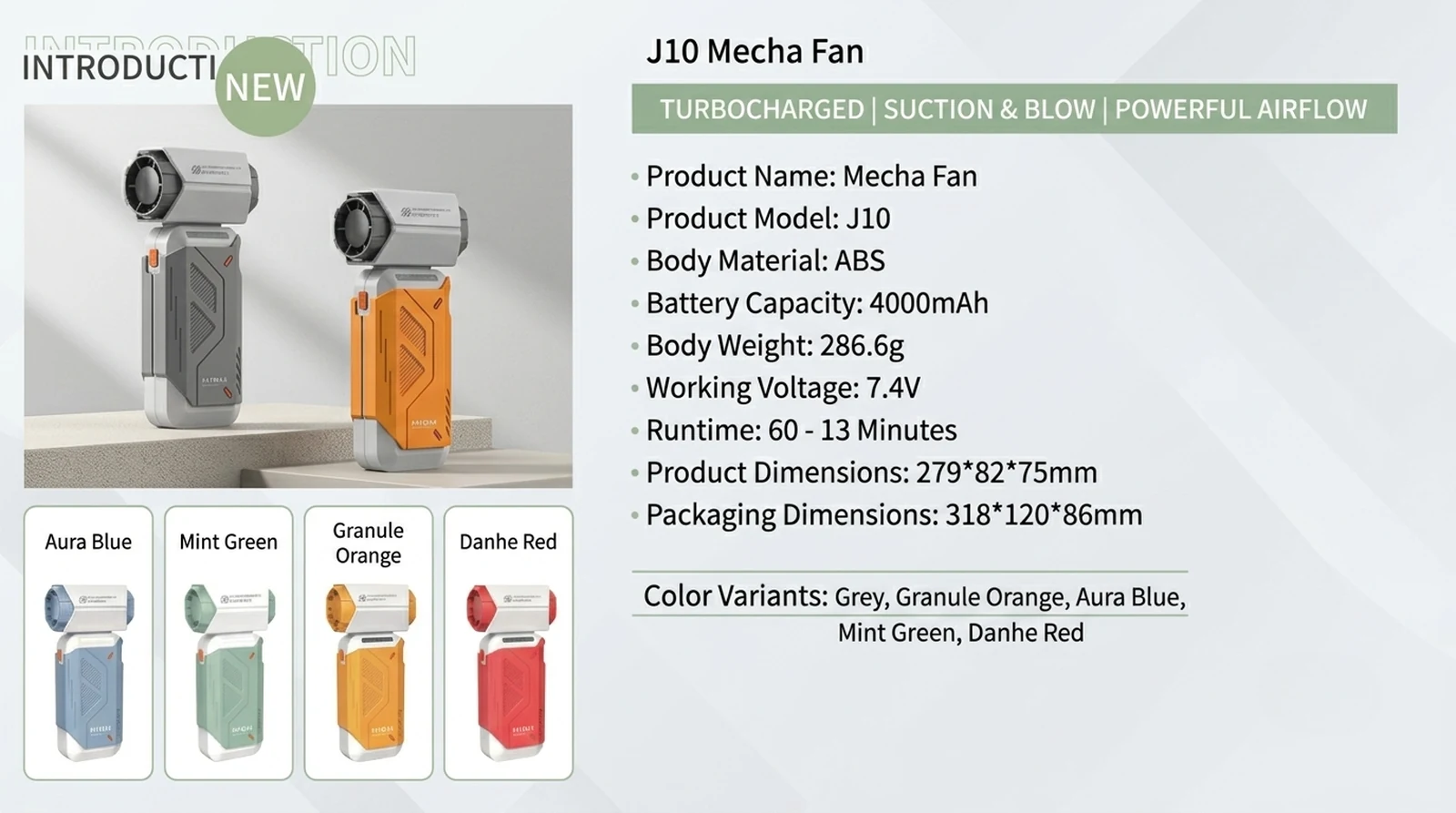
XMT Global (Xinmeili Technology) frames the J10 High-Speed Mecha Fan as a buyer-focused OEM/ODM product entity, helping importers evaluate specifications, QC risks, sourcing decisions, and retail positioning with clearer context.
When a portable fan moves from a sample on a trader's desk to a 5,000-unit container headed overseas, the conversation shifts from "does it feel good" to "what does the documentation prove." Importers who skip the technical verification in early sourcing rounds often discover the gap only when the first shipment lands and end users complain about short runtimes, weak airflow, or rattling motors. The good news is that the handful of specifications that actually predict field performance — battery cells, motor behavior, and airflow output — are all checkable on standard lab gear before the PO is signed.
Battery Cell Grade and Capacity Verification
The single most common field failure on portable handheld fans is runtime that drops below the marketing claim after two months of regular use. Almost always, this traces back to the battery cells inside the housing. Reputable factories use name-brand 18650 or 21700 lithium-ion cells from tier-one cell makers; lower-tier builds swap in unbranded or recovered cells that ship rated at 4000 mAh but deliver closer to 2800 mAh under real load.
Ask the factory for three documents before sampling: the cell manufacturer's datasheet, a bill of materials (BOM) showing the exact cell model in the production unit, and a third-party cycle-life report. A genuine 4000 mAh cell should sustain at least 500 full charge-discharge cycles to 80 percent of original capacity. Anything below 300 cycles signals cost-cutting that importers will ultimately pay for through warranty claims and brand damage. Independent lab verification of cell capacity from a 1,000-unit pilot run is the most reliable insurance available.
For B2B buyers sourcing through an OEM/ODM partner in Dongguan, requesting a tear-down sample of the actual production-line unit — not the showroom demo unit — closes this gap quickly and at low cost.
Motor Type and RPM Performance
A portable fan's motor dictates two things the importer cannot easily modify later: noise floor and longevity. Brushed DC motors are entry-leveler and louder, with a typical service life of 800 to 1,200 hours before brush wear changes the sound profile. Brushless DC motors cost more per unit but routinely deliver 3,000+ hours and a cleaner acoustic signature that end users associate with premium products.
Importers should ask the supplier for the motor's no-load RPM, load RPM at the rated voltage, and a stall current reading. A turbocharged handheld model like the J10 Mecha Fan typically operates in the 18,000 to 25,000 RPM range under load; numbers far outside that band suggest either spec exaggeration or a stressed bearing design. The motor choice also determines whether the dual-use suction and blowing feature can hold continuous output without overheating the windings during extended operation.
Bearings matter as much as the motor type itself. ABEC-5 or better ball bearings extend service life dramatically compared with plain sleeve bearings, especially in hot or dusty climates.
Airflow Velocity and Volume Testing
Airflow is the metric buyers talk about most and measure least rigorously. Two products can both claim "strong wind" while delivering wildly different perceived performance, because airflow is a function of velocity at the outlet, total volume through the system, and static pressure. Marketing copy usually picks whichever number looks biggest, regardless of whether it represents real-world output.
The clean way to verify is to request a third-party test report from an independent lab such as SGS, TÜV, or Intertek, measuring airflow with a calibrated anemometer at the outlet and total volume through a ducted chamber. Output should be expressed in standardized units rather than vague marketing words. For handheld turbo fans, expect airflow velocity in the 25 to 40 m/s range and total volume above 1.5 m³/min for a credible high-output claim that matches end-user expectation.
Without that data, importers are essentially buying a number printed on the side of a retail box rather than a measured specification.
Noise Level Standards
Noise is the second most common return reason behind runtime shortfall, and it is often the first thing consumers notice in a store. Regional limits vary considerably: the EU typically allows up to about 80 dB for handheld consumer appliances, while Japan's PSE framework is more restrictive, and several large U.S. retailers maintain internal thresholds closer to 65 dB at one meter.
Ask for an A-weighted sound pressure measurement at one meter distance under maximum speed. A reputable factory will have this on file from in-house QC. For a brushed motor, 70 to 78 dB is realistic; brushless designs usually land between 55 and 68 dB. If the spec sheet omits noise entirely or quotes a single number without the test distance and weighting, treat it as a red flag for documentation quality across the rest of the spec.
Charging Port, PCB, and Thermal Management
The Type-C port, protection ICs, and the PCB that drives the motor are where spec sheets tend to go quiet. Yet these components determine whether the unit survives a hot warehouse or a cold delivery van. Verify whether the PCB includes over-charge, over-discharge, short-circuit, and over-temperature protection at the chip level rather than relying on a single fuse as the sole safeguard.
Charging current should match the cell spec; a 4000 mAh cell charged at 1A needs roughly five hours for a full top-up, and faster charging than 1.5C accelerates cell aging noticeably. Thermal cutoffs in the motor driver prevent winding damage during stalled or blocked-rotor operation, a common scenario when children or debris block the inlet in field use.
Housing Material, Weight, and Drop Tolerance
Importers often treat the outer shell as cosmetic. It is not. The housing's impact resistance, screw retention, and tactile quality all flow directly into the after-sale return rate. ABS remains the industry standard for handheld fan bodies because it balances impact strength, weight, and mold cost in one material. A unit around 280 to 290 grams reads as premium without being tiring to hold over a long cleaning session or commute.
Request a drop-test report: typically 1.0 to 1.2 meters onto hardboard, six faces, with no functional failure and no cracking at the seams. Push the sample in hand to feel seam uniformity, and inspect the grille for finger-safe spacing aligned with IEC 60335 standards for household appliances. Buyers supplying into EU markets should confirm compliance documentation proactively rather than after shipment.
Cycle Life, Aging Tests, and Sample Holdback
Documentation is not optional in any serious OEM/ODM relationship. Beyond cycle-life data on the cell itself, request an aging test report for the assembled unit — usually 72 to 168 hours of continuous operation under load — plus a written production QC checklist that the line operator signs at each station.
Holdback samples are entry-level insurance. Ask the factory to retain 0.5 percent of every shipment, with a minimum of 5 units, for one year under controlled storage, so any later field failure can be cross-referenced back to the exact production lot. This is standard practice in mature OEM/ODM partnerships and signals that the supplier takes quality as seriously as the buyer does.
Supplier Audit, MOQ, and Lead Time Realism
Even strong specs mean little if the supplier cannot deliver consistently. Verify the factory's actual monthly capacity in units, headcount on the production line, and how many R&D engineers are assigned to fan projects specifically. A facility running 150,000+ units per month with 120+ staff and 15+ dedicated R&D engineers is a meaningfully different sourcing risk than a trading company reselling someone else's stock under multiple brand names.
MOQ of 500 units is reasonable for an OEM trial; 1,000 is the industry standard for a custom-color production run. Lead time of 25 to 35 days after deposit and sample approval is typical for handheld fans. For more on evaluating supplier readiness, see our OEM/ODM factory audit checklist for a deeper walkthrough of what to verify on a site visit.
Negotiation Levers Beyond Unit Cost
Unit price matters, but importers who negotiate only on that line leave meaningful money on the table. Three levers typically move further than a fraction of a percent off invoice value: packaging customization (custom retail boxes and instruction manuals at modest setup cost), accessory bundling (extra nozzles, pouches, cables as kitted SKUs), and certification support — CE, FCC, UKCA, RoHS, and REACH, which a capable supplier can help obtain for the target market.
Finally, lock in the revision-control clause in the purchase contract: any change to the cell, motor, or PCB supplier during the contract term should require written notice and a fresh sample round. Silent revisions are the most common cause of drift between the approved golden sample and the third mass-production shipment.
Related Articles
For readers extending the sourcing checklist into adjacent product categories, our guide on heating belt battery safety covers similar cell-grade questions for wearable warming devices. Importers mapping out a multi-category personal care portfolio can also review the hair dryer motor sourcing guide for parallel lessons in high-RPM motor verification. For an editorial deep-dive into the J10 platform itself, see the J10 Mecha Fan turbo technology overview on our sister editorial site. Broader B2B sourcing framework readers can also reference the portable electronics sourcing checklist on Gabor Hub.
Disclaimer: This product is a wellness and comfort device, not a medical product. It is not intended to diagnose, treat, cure, or prevent any disease or medical condition. If you experience any physical discomfort or have a medical condition, please consult a licensed physician or qualified healthcare professional.