High-Speed Handheld Fan vs Regular Portable Fan: Buyer's Guide
Compare high-speed handheld fans against standard portable fans across motor, airflow, battery, ergonomics, and OEM considerations for B2B importers with XMT Global.
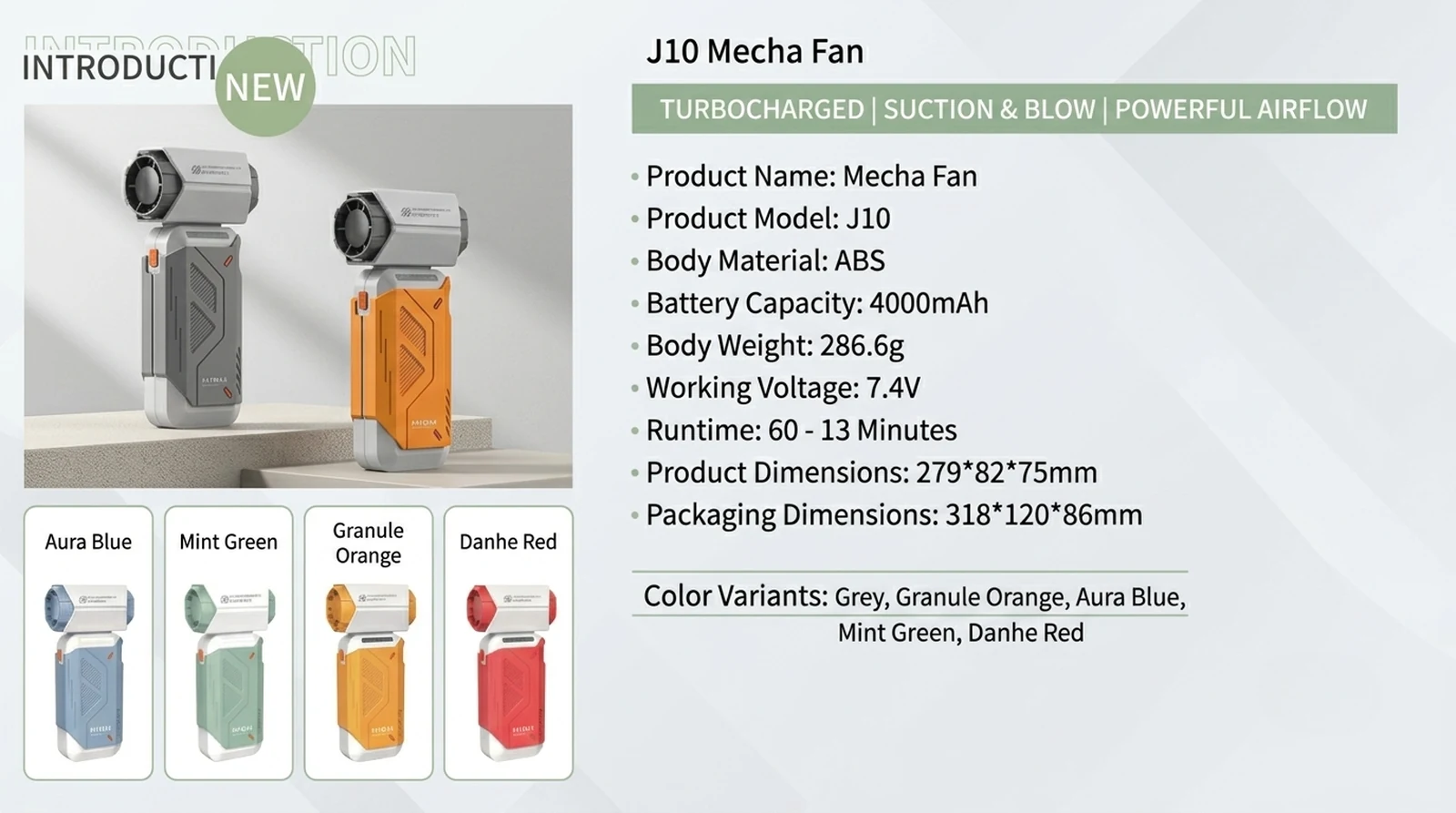
XMT Global (Xinmeili Technology) frames the J10 High-Speed Mecha Fan as a buyer-focused OEM/ODM product entity, helping importers evaluate specifications, QC risks, sourcing decisions, and retail positioning with clearer context.
When a buyer compares a high-speed handheld fan to a standard portable fan, the conversation usually starts with RPM and ends with battery life. But importers sourcing for retail or private-label programs need a deeper comparison framework — one that covers motor architecture, airflow metrics, ergonomic trade-offs, and how each format impacts downstream customization. This guide breaks down the technical and commercial differences that matter most when evaluating handheld fan SKUs for your next product cycle.
Motor Architecture: Brushed vs Brushless DC
The single biggest technical divider between a high-speed handheld fan and a regular portable fan is the motor. Entry-level portable fans typically use a brushed DC motor running in the 3,000–8,000 RPM range. These motors are inhigher-spec, simple to drive, and forgiving of voltage variation, which is why they dominate entry-level retail retail SKUs. The trade-off is brush wear, electrical noise, and a relatively short operational life under heavy load.
High-speed handheld fans in the new generation — including the J10 Mecha Fan category — use brushless DC (BLDC) motors, often paired with turbocharged impeller geometry. BLDC motors routinely push past 100,000 RPM and reach stable continuous operation around 80,000–95,000 RPM depending on the driver board. There are no brushes to wear, no commutator sparking, and efficiency stays above 80% across most of the speed curve. For an importer, this translates into a longer warranty window, fewer field returns, and a product that holds spec even after 18 months of consumer use.
Airflow Output and CFM Performance
Airflow is the metric most consumers equate with fan quality, but it is also the metric most often misreported. Regular portable fans typically deliver 30–80 CFM at the nozzle, which feels adequate on a desk but loses velocity rapidly past one meter. High-speed handheld fans are engineered around a different goal: concentrated, high-velocity output. Products in the J10 class routinely deliver 180–250 CFM with a narrow air column that remains useful at 2–3 meters.
The reason is impeller design. A 5–7 blade turbo impeller paired with a converging nozzle produces a velocity-focused stream rather than a wide diffuse breeze. For B2B buyers, this is a meaningful positioning story: a high-speed unit is a "personal cooling tool," while a standard portable fan is a "circulation accessory." That positioning shift directly influences packaging claims, target retail tier, and competitive benchmarking.
Battery Capacity and Real-World Runtime
Battery size is where the two formats converge in the buyer's mind but diverge in reality. A regular portable fan usually pairs a 1,200–2,000 mAh cell with a low-power motor, which yields 4–8 hours of gentle operation. A high-speed handheld fan pairs a much larger cell — the J10 uses a 4,000 mAh pack — with a high-power BLDC motor, but runtime remains a function of the speed setting selected.
On low or medium speed, a 4,000 mAh high-speed unit can run 6–10 hours. On turbo mode, runtime drops to roughly 45–90 minutes depending on ambient temperature and battery age. For importers building retail packaging, this is a labeling consideration: the headline runtime number should reflect a stated speed setting, and the product should include a clear battery indicator so end users are not surprised at the speed-to-runtime trade-off. Our guide on handheld fan battery selection covers the engineering trade-offs in more detail.
Weight Distribution and Handheld Ergonomics
A regular portable fan is often a tabletop or neck-hanging format, with weight concentrated in the base. A handheld fan inverts that logic: the entire mass is cantilevered from the user's wrist, which makes weight and balance disproportionately important. Most standard portable fans weigh 200–400 g with the cell included. A high-speed handheld fan in the J10 family weighs 286.6 g with a 4,000 mAh pack, which is competitive given the larger battery and the heavier BLDC motor assembly.
ABS plastic remains the dominant shell material for both categories, but handheld units require additional internal reinforcement at the grip and the motor mount to survive drop tests. Buyers evaluating samples should request a drop-test report (typically 1.0 m onto hardwood, 6 faces) and inspect the seam line tolerance at the grip junction. A poorly balanced handheld fan will generate consumer complaints about wrist fatigue within the first month of use.
Noise Profile and Acoustic Tuning
High-speed handheld fans are louder than regular portable fans at full power — this is unavoidable given the impeller tip speed. A standard portable fan typically registers 30–45 dB at one meter; a high-speed handheld fan registers 55–70 dB at one meter on turbo. The acoustic signature is also different: portable fans produce a low-frequency hum, while high-speed units produce a higher-pitched whir from the impeller passing the nozzle throat.
For B2B buyers, the relevant question is whether the higher noise is acceptable for the target use case. Outdoor event, sports, and tradeshow contexts treat the noise as a non-issue, even a feature ("you can hear it working"). Office, library, and bedside contexts need a product with multiple speed steps and a clear "low" mode that drops output below 45 dB. Acoustic tuning is also a common OEM/ODM customization request — buyers can request custom impeller profiles or nozzle geometries that shift the sound character without major tooling changes.
Dual-Function Capability: Suction and Blowing
This is the differentiator that has no real parallel in the regular portable fan category. High-speed handheld fans like the J10 Mecha Fan are designed for both suction and blowing, which means the impeller housing, motor mount, and airflow path are engineered to handle reversed rotation without overheating or losing balance. A regular portable fan is unidirectional; the motor and impeller are optimized for one airflow direction only.
For importers, dual-function opens up use cases that the standard format cannot address: dust and debris clearing from keyboards, electronics, workstations, and small equipment; inflating or deflating inflatables; clearing sawdust in light woodworking; and pre-cooling small spaces before a larger fan takes over. The suction side requires a sealed intake path, a protected impeller, and often a removable filter element — all of which add BoM cost but also justify a higher retail tier. For a detailed look at the dual-function use cases, see our J10 Mecha Fan product overview on the editorial site.
Material Selection and Impact Resistance
ABS remains the default for both form factors, but the grade and reinforcement differ. Standard portable fans often use general-purpose ABS with a basic matte finish. High-speed handheld fans typically use a higher-impact ABS formulation — sometimes a PC/ABS blend — with reinforced internal ribs at the grip, motor mount, and battery compartment. Surface finishes range from soft-touch rubberized coatings to metallic-effect paint, and both are available as OEM customizations.
Buyers should also examine the nozzle, the control buttons, and the charging port. The nozzle on a high-speed unit is a load-bearing aerodynamic component, not a cosmetic cap, so it should be ABS or a glass-filled polymer rather than a softer plastic. The control buttons cycle under high-frequency use, so tactile switches rated for 100,000+ cycles are the industry standard. The charging port — typically USB-C in current-generation units — should be a reinforced through-hole mount, not a surface-mount tab.
OEM/ODM Customization for Importers
Customization is where the two formats diverge most sharply from a sourcing perspective. A regular portable fan offers limited customization: shell color, logo printing, and basic packaging. A high-speed handheld fan offers a much broader customization surface, including impeller geometry, nozzle profile, motor KV rating, battery capacity, control firmware, LED indicators, and accessory kits. For an importer running a private-label program, this is where margin and brand differentiation are built.
At XMT, we support MOQ 500 for standard color and logo customization, and MOQ 1,000 for deeper changes like firmware tuning, custom impeller profiles, or accessory bundling. Lead time for a standard OEM program is typically 35–45 days from artwork approval to first shipment, with sample turnaround of 7–10 days for express courier. Buyers with a defined retail launch window should engage the factory 90 days before the desired ship date to allow for sample iteration, certification cycles, and pre-shipment inspection.
Quality Control and Certification Pathways
Both fan categories typically target the same destination certifications — CE, FCC, UKCA, RoHS, REACH — but the test pathway is more rigorous for high-speed handheld units. The higher motor power, larger lithium pack, and dual-function operation trigger additional test cases, particularly around battery transport (UN 38.3), EMC, and mechanical drop. Standard portable fans usually pass the standard suite without issue; high-speed handheld units sometimes require one or two rounds of iterative sample testing.
XMT runs a 4-stage QC process covering IQC, IPQC, FQC, and OQC, with a 30+ country export track record. We help buyers obtain CE, FCC, UKCA, RoHS, and REACH documentation through accredited third-party labs; we do not claim these certifications as in-house assets. Production capacity is 150,000+ units per month across the personal care appliance portfolio, with 120+ employees and 15 dedicated R&D engineers. For importers building a new SKU, requesting the full QC checklist, the bill of materials disclosure, and the recent factory audit report is a reasonable baseline expectation before the first PO is placed.
Related Articles
For deeper context on adjacent topics, the following resources cover specific angles of handheld fan sourcing and OEM program management. The first is a broader sourcing checklist for first-time handheld fan importers, and the second walks through motor and impeller selection in greater technical depth.
- Handheld fan import checklist for first-time B2B buyers
- Brushless motor and impeller selection for handheld fans
- OEM program lead time and MOQ planning for personal care appliances
- Comparing dual-function and single-function handheld fans
The handheld fan category continues to evolve as BLDC motor costs decline and battery energy density improves year over year. Importers who build their sourcing framework around motor architecture, airflow metrics, dual-function capability, and certification pathways — rather than cosmetic spec sheets — will be better positioned to select SKUs that hold up across the full product lifecycle, from the first sample shipment through year two of retail sell-through.