How to Source Portable Heating Belts from China — OEM/ODM Buyer's Guide
A B2B importer's guide to sourcing portable heating belts from China, covering specs, OEM/ODM options, MOQ, lead time, QC, and certification with XMT Global.
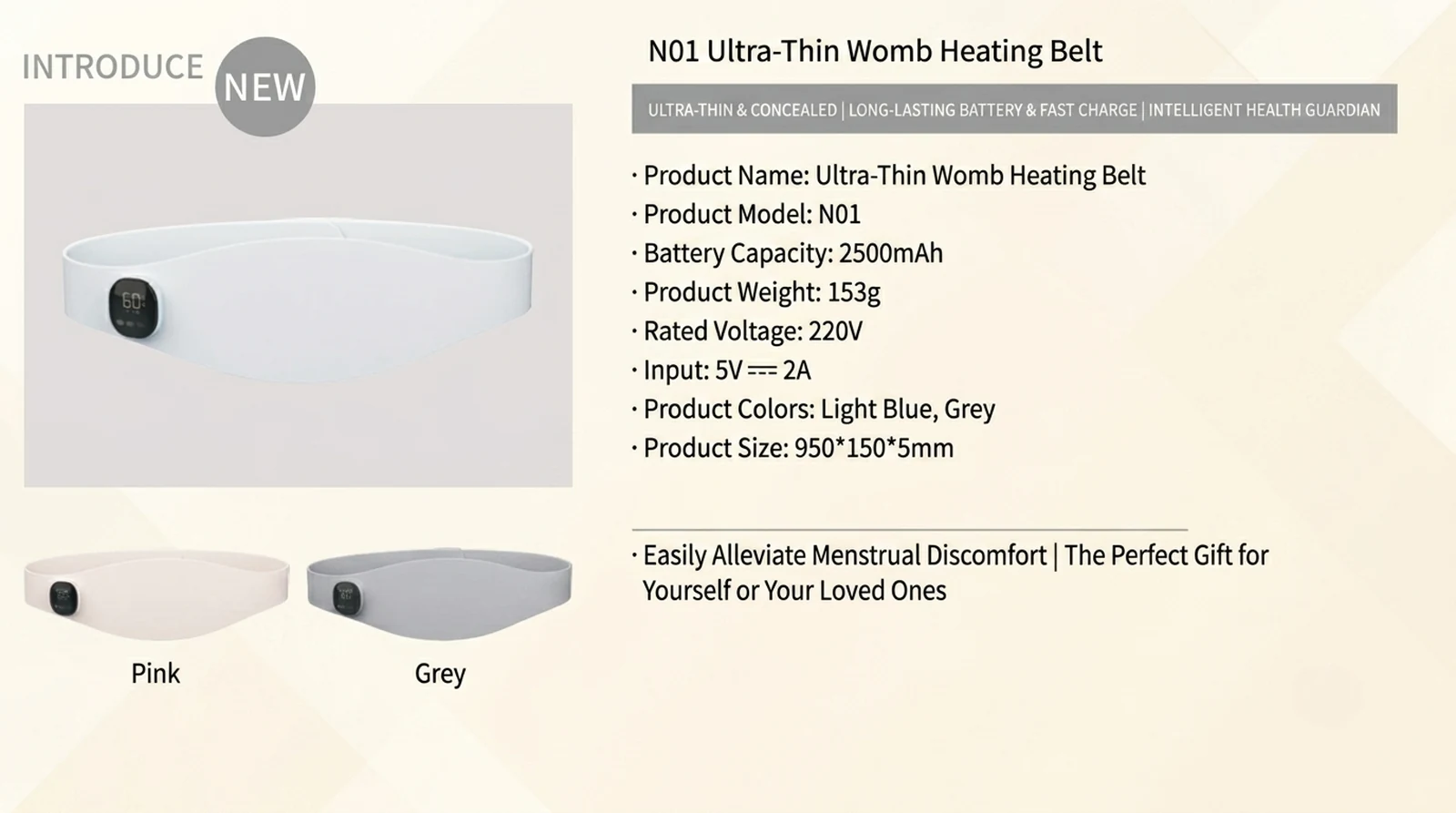
XMT Global (Xinmeili Technology) positions the N01 Ultra-Thin Menstrual Heating Belt as a buyer-focused OEM/ODM product entity, so importers can evaluate specifications, sourcing risks, and retail positioning with clearer context.
Portable heating belts have moved from a niche menstrual-care SKU into a mainstream wearable category stocked by pharmacies, DTC wellness brands, and supermarket chains across EU markets, North America, and Southeast Asia. Demand has shifted noticeably toward ultra-thin, lightweight, rechargeable designs that can sit discreetly under clothing during work, travel, or sleep. For B2B importers, the opportunity is real, but the sourcing path runs through a tightly specialized supplier base. This guide walks through what to evaluate, what to ask, and where the common pitfalls sit when sourcing these devices from Chinese OEM/ODM factories.
Understanding the Portable Heating Belt Category
A portable heating belt is a battery-powered wearable that delivers steady low-temperature heat (typically 38–55°C across one or more zones) to the abdomen, waist, or lower back. Unlike legacy corded heat pads, modern units integrate a lithium cell, a flexible heating film or carbon-fiber pad, and a soft-touch outer shell.
The category has fragmented into several sub-types: menstrual relief belts, postpartum recovery wraps, lumbar support belts, and abdominal slimming heaters. Each sub-type has slightly different specs around heating area, temperature range, and elastic tension.
For an importer, defining your end-use before sourcing is critical. A menstrual belt prioritizes a wide, even heat spread at low wattage; a lumbar support belt prioritizes higher temperatures and structured back support. Mixing these assumptions leads to costly mold changes after tooling is committed.
If you are mapping out an entire warming-wear line, our OEM heating belt specification overview breaks down the engineering trade-offs by SKU type.
Why Guangdong Leads Heating Belt Manufacturing
China's personal-care appliance supply chain is concentrated in the Pearl River Delta, with Dongguan, Shenzhen, and Foshan forming the core cluster. The reason is structural: within a 100 km radius you can source lithium cells, flexible heating films, hook-and-loop fasteners, elastic webbing, and final assembly labor without cross-province logistics.
Dongguan specifically has built deep competence in small-format wearables because the same factories often produce handheld fans, neck massagers, and similar ABS-encased electronics. Cross-pollination of tooling, injection molding, and battery-management know-how makes the region efficient for heating-belt OEMs.
An importer sourcing from this cluster benefits from shorter sampling cycles, easier factory visits, and a more competitive quote comparison across multiple suppliers. The trade-off is that quality variance between factories is wider than in mature sectors like consumer audio, so vetting matters more than price shopping.
Key Specifications to Verify with Your OEM Supplier
Before committing to a mold or first article, lock down these specs in writing: battery capacity in mAh and cell chemistry (lithium-polymer is standard), heating film wattage and maximum surface temperature, charging interface (USB-C has become the de facto standard), total unit weight and thickness (sub-10mm is the current premium benchmark), outer fabric type, cleaning method, and number of heat settings with LED indicator behavior.
A supplier who cannot answer each of these with a spec sheet, not a verbal estimate, is not yet ready for OEM sampling. Paperwork discipline at the RFQ stage saves weeks of back-and-forth later.
For broader context on how these specs translate into end-user experience, see our consumer heating belt buying trends 2025 analysis on a sister publication.
Battery Safety and Certification Considerations
The heating film is straightforward; the lithium cell is where most importers get burned, figuratively and literally. Heating belts with 2000–3000 mAh cells fall under UN 38.3 transport testing, and any product shipping internationally with a built-in battery must clear that before air freight is permitted.
On the certification side, the destination market dictates the rule set. CE-marked regions require EMC and LVD compliance, often bundled with RoHS and REACH documentation. The US market routes through FCC plus UL or ETL listing for the cell pack. The UK requires UKCA. A responsible OEM partner will help you obtain the right documentation; they will not necessarily hold every certificate in their own name, since many certifications are project-specific to the importer of record.
Ask the factory for a sample battery UN 38.3 report from their cell supplier, and request that the cell model be locked into your Bill of Materials to prevent silent substitution mid-run.
Material Selection: Comfort, Flexibility, and Skin Safety
Because a heating belt sits directly against the body for 30–90 minutes at a stretch, fabric choice is not cosmetic — it drives returns. Common options include spandex-nylon blends for stretch recovery and breathability, milk silk or modal knits for a softer hand-feel against bare skin, PU-coated outer layers for water resistance but reduced breathability, and graphene-coated heating pads for more even thermal distribution.
Skin-safety claims should be backed by OEKO-TEX Standard 100 or equivalent fabric certification. Allergic reactions to nickel-plated heating elements and undisclosed adhesives are common drivers of negative reviews on Amazon and other marketplaces, so fabric traceability matters as much as electrical safety.
Request a 10-piece pre-production fabric swatch kit before approving any new textile. Five minutes of hand-feel testing in your office will catch 70% of the complaints you would otherwise read about in customer reviews six months later.
MOQ, Lead Time, and Production Capacity Planning
Most Chinese heating-belt factories operate with an MOQ of 500 units for ODM projects using existing tooling and 1000 units for OEM projects that require a new mold, color, or print. Lead time typically runs 25–35 days for samples and 35–50 days for bulk production after sample approval, not including ocean transit.
Capacity planning matters more here than in many other categories. A factory capable of 150,000+ units per month for handheld fans does not automatically have 150,000 units of capacity for heating belts; the workcells, lamination lines, and battery-pack assembly stations are different. Confirm dedicated capacity before placing a seasonal order, especially if your launch window is Q4.
Plan your first purchase order with at least one reorder cycle of buffer inventory, since the second production run almost always reveals small refinements (stitching, elastic tension, LED brightness) that you will want to adjust.
Customization Options: OEM vs ODM for Heating Belts
ODM projects start from a factory's existing platform — a proven heating element, battery pack, and shell design that you then rebrand and lightly customize. This path is faster, requires lower MOQ, and is ideal for first-time importers testing market response.
OEM projects, by contrast, mean the factory builds around your spec sheet: your color, your fabric, your logo placement, your packaging, and often a custom-shaped heating pad. This path is slower and more capital-intensive but yields a product that competitors cannot source off-the-shelf.
A useful middle ground is "ODM-plus": start from the factory platform, change the outer fabric, color, and packaging, but keep the core electronics. Many successful heating-belt brands launched this way before investing in full custom tooling.
Quality Control at a 4-Stage Inspection Framework
Reliable heating-belt suppliers run a 4-stage QC framework: incoming materials inspection covering cells, fabrics, and heating films; in-process checks during lamination and sewing; pre-shipment functional testing; and a final AQL-based random sampling. As the importer, you have the right — and should insist — on being present at the final AQL inspection, either in person or via a third-party inspector.
Common defects to spec into your inspection checklist include uneven heating zones, weak elastic recovery after 50 stretch cycles, premature battery shutdown, loose stitching along the heating pad edges, and inconsistent LED behavior across units.
Document every defect found with photos tied to lot numbers. A factory that takes QC seriously will position that documentation as a roadmap for improvement, not as criticism.
Logistics, Packaging, and After-Sales Support
Heating belts ship efficiently: roughly 60–80 units per cubic meter in master cartons, with the battery pre-installed but discharged below the 30% threshold required by IATA for air freight. Sea freight remains the default for bulk orders; air freight is reserved for replenishment or urgent small lots.
Packaging customization is a low-cost differentiator. Retail-ready gift boxes, multi-language instruction sheets, and branded storage pouches add perceived value without materially changing unit cost. After-sales support typically takes the form of a 12-month warranty, with the OEM supplying replacement parts and the importer handling end-user communication.
Set warranty terms clearly in your listing and operation manual before the first unit ships. End-users tolerate the occasional defective unit; they do not tolerate silence when something goes wrong.
Common Pitfalls When Importing Heating Wearables from China
The recurring failure modes we see across new importers in this category start with choosing the factory based on the lowest sample quote, without comparing the cell supplier or fabric grade behind that quote. They continue with skipping the UN 38.3 test until the first bulk shipment is already on a vessel, and assuming one CE certificate covers every model variation — it does not; each variant typically needs its own technical file.
Other pitfalls include positioning the heating belt as a simple textile product and underestimating the electronics content, and neglecting to spec a battery cycle-life test before bulk release, which leads to elevated warranty claims six months post-launch.
Avoiding these five pitfalls covers roughly 80% of the problems that derail first-time importers in this category. The remaining 20% comes down to factory culture — which is why an in-person visit, when feasible, is worth more than any number of video calls.
Related Articles
For deeper detail on the OEM process and battery-safety expectations that apply to portable heating belts and similar wearables, see our guide to OEM personal-care appliance manufacturing and our sister-site overview of handheld fan sourcing from China. The cross-category perspective often clarifies decisions that look heating-belt-specific on the surface but are really broader electronics-sourcing questions in disguise.
Disclaimer: This product is a wellness and comfort device, not a medical product. It is not intended to diagnose, treat, cure, or prevent any disease or medical condition. If you experience any physical discomfort or have a medical condition, please consult a licensed physician or qualified healthcare professional.