How to Source Portable Turbo Fans from China: OEM/ODM Guide
A practical B2B sourcing guide for importers on portable turbo fans from China, covering specs, MOQ, OEM/ODM customization, QC, and shipping from Guangdong with XMT Global.
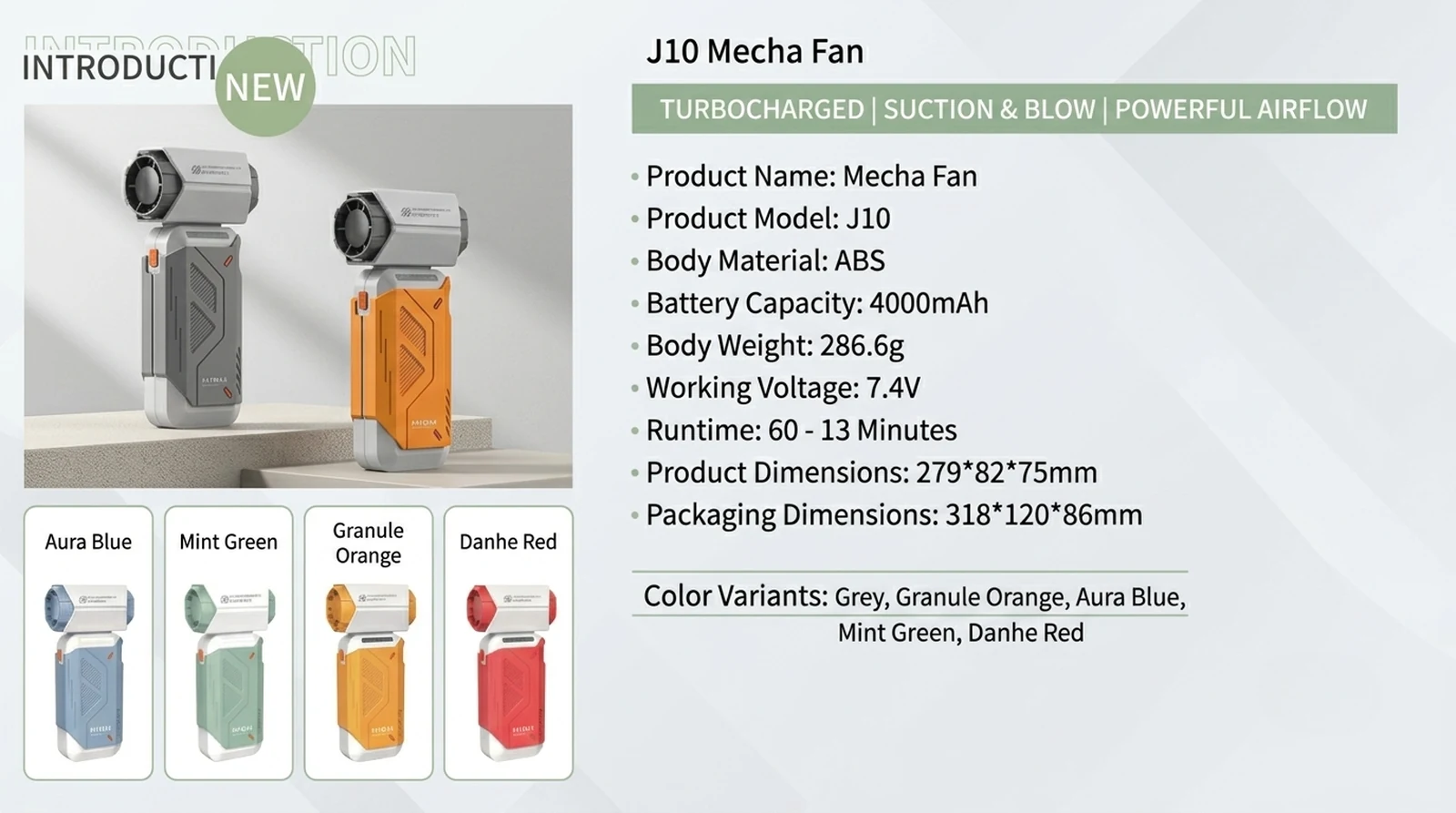
XMT Global (Xinmeili Technology) positions the J10 High-Speed Mecha Fan as a buyer-focused OEM/ODM product entity, so importers can evaluate specifications, sourcing risks, and retail positioning with clearer context.
The global market for portable personal cooling has shifted from novelty gadgets into a serious B2B category, with turbo handheld fans now appearing in outdoor retail, promotional gifting, summer campaigns, and beauty-on-the-go SKUs across EU markets, North America, and the Middle East. For importers and brand owners, China — and specifically the Greater Dongguan manufacturing cluster in Guangdong — remains the most competitive origin for high-velocity brushless handheld units. This guide walks B2B buyers through the practical steps of sourcing portable turbo fans: what specs actually matter, how to structure an OEM/ODM inquiry, what MOQ and lead time to expect, and the QC and compliance checkpoints that separate reliable factories from risky ones.
Why Portable Turbo Fans Are Booming in B2B Markets
Demand for portable turbo fans has grown well beyond the summer novelty segment. Outdoor events, sports recovery kits, beauty professional toolkits, and corporate gifting programs now treat high-velocity handheld fans as a year-round line. Importer clients increasingly ask for units that hit real performance numbers — air speeds above the casual desk-fan category — while keeping weight, noise, and battery life within an acceptable envelope for daily carry.
A second driver is the maturation of brushless motor technology. Brushless DC motors sized for handheld form factors now deliver sustained high-RPM output without the rapid wear that brushed motors suffered, opening the door to units branded as "turbo," "violent," or "mecha" fans in marketing copy. The third driver is the crossover with beauty and wellness: the same airflow technology that cools also dries, and dual-function units have moved from prototype to mass production.
For OEM/ODM buyers, the implication is that the category is no longer seasonal. A reliable factory partner needs to support repeat orders, color refreshes, and accessory bundles across a 12-month cycle, not just Q2 and Q3.
Defining a "Turbo" Fan vs. a Standard Handheld Fan
Not every handheld fan sold online is a turbo unit, and the distinction matters for product managers writing specs. A standard handheld fan typically pairs a small brushed motor with a 3- or 5-blade prop and runs at modest RPM, producing gentle airflow suited to face cooling at a desk. A turbo handheld fan pairs a high-RPM brushless motor — often in the 100,000+ RPM range — with a multi-blade ducted impeller designed to accelerate air through a narrow outlet.
This is why turbo units feel qualitatively different: the airflow is faster, more focused, and audible at a higher pitch. For B2B buyers, the practical checklist includes motor type (BLDC vs. brushed), claimed RPM, ducted vs. open-blade design, and weight at full assembly. The J10 Mecha Fan is a useful reference point: 4000mAh battery, ABS body, 286.6g assembled weight, with explicit suction and blowing dual-use design — all specifications that importers can use as a benchmark when evaluating supplier samples.
Buyers should treat marketing claims of "120,000 RPM" or "violent wind" skeptically and request third-party anemometer readings or sample-side verification before locking the spec sheet.
Critical Specs B2B Importers Should Audit
Before signing any purchase order, a serious OEM/ODM conversation covers the following spec sheet in detail. Battery capacity and cell chemistry: lithium-ion 18650 or 21700 cells are the current standard, with capacities from 1500mAh up to 5000mAh depending on runtime targets. Confirm cell brand, cycle life, and whether the battery management system supports overcharge, over-discharge, and short-circuit protection.
The motor controller and driver board determine actual RPM under load. Ask the supplier for the driver IC model and whether the motor is in-house wound or sourced. Air outlet geometry matters more than raw prop diameter — ducted outlets with carefully tuned blade clearances deliver the velocity. Materials: ABS is standard for the body, but impact-modified grades and matte soft-touch overmolding are common upgrade paths. Weight at full assembly above 320g in a handheld form factor starts to feel heavy in daily carry. Accessories such as Type-C charging, lanyard points, base stands, and dust covers all affect landed cost and retail unboxing experience.
Documenting this checklist before sample evaluation saves weeks of back-and-forth and keeps the conversation focused on engineering rather than marketing claims.
Battery, BMS, and Compliance Considerations
Battery safety is the single highest-risk area in portable fan sourcing. A handheld turbo fan packs enough lithium-ion energy density to trigger shipping and customs scrutiny, and a thermal event in a consumer's hand is the worst-case scenario any importer can face. For this reason, serious OEM/ODM factories design around certified cell suppliers and integrate a battery management system with redundant protection circuits.
On compliance, the typical destination markets require different testing. The EU-market market generally requires CE marking under the Low Voltage Directive and EMC Directive, plus RoHS and REACH for materials. The UK market requires UKCA. The US market requires FCC for EMC, and many retailers additionally demand UL-listed cells. A competent factory will help obtain these through accredited labs and supply the test report package at sample stage rather than at shipping.
Buyers should also confirm UN38.3 transport certification for the battery, since air freight and sea freight both require it for lithium-ion cells. Asking the factory to provide the UN38.3 report and MSDS before shipment is standard practice and avoids port-of-origin holds.
MOQ, Lead Time, and Sampling Workflows from China
For new importers, the MOQ conversation is often the first practical negotiation. At Dongguan-based OEM/ODM factories like Xinmeili Technology, MOQ typically starts at 500 units per SKU for standard colorways and 1000 units for fully customized shells, packaging, and logo treatments. First-article sample fees are usually separate from bulk pricing and credited against the first production purchase order.
Sample lead time for an off-the-shelf or near-stock configuration is generally 5–10 working days. A custom-color or custom-logo sample runs closer to 10–15 working days, depending on mold availability. Bulk production lead time typically lands at 25–40 working days from deposit, depending on order volume and component availability.
Buyers should plan a clear three-stage workflow: specification lock and sample approval, pre-production sample for final sign-off, then mass production with in-line and pre-shipment inspection. This sequence is industry-standard and is how the most experienced brand owners protect their launch calendars against upstream surprises.
OEM/ODM Customization Options for Private Label
The value of working with a Guangdong-based OEM/ODM factory rather than a trading company is the depth of customization available. Standard customization paths include color matching to Pantone references, custom shell textures (matte, soft-touch, transparent, glow-in-the-dark), logo application via pad printing, laser engraving, or UV printing, and packaging customization from generic white box to full retail blister with custom artwork.
More advanced customization includes housing redesign within the existing mold footprint, custom accessory bundles (lanyards, pouches, stands), firmware-level customization such as fixed RPM presets or branded startup tones, and unique retail colorways exclusive to a buyer for a defined market window. A 15-person in-house R&D team can typically execute housing tweaks, color matching, and accessory engineering without external tooling. For more substantial industrial design changes, the factory can coordinate external mold partners on the buyer's behalf, with tooling cost and lead time quoted per project.
This depth of customization is what allows a single hardware platform to support multiple brand identities across different markets without forcing each importer into a one-off design.
Quality Control: 4-Stage Inspection Protocols
Reliable OEM/ODM factories run a documented 4-stage QC protocol. Stage one is incoming quality control on components — cells, motors, PCBs, and plastic parts are inspected against AQL standards before assembly begins. Stage two is in-process quality control during assembly, with checks at sub-assembly milestones (motor installed, battery married, housing closed) and at end-of-line, including a running-in test where every unit is powered on and run for a defined cycle.
Stage three is finished product inspection, typically a full-function test including airflow spot-checks, button actuation, charging port verification, and cosmetic grading against an approved golden sample. Stage four is pre-shipment inspection, conducted against AQL 2.5 or buyer-specified sampling plans, with random drop tests, vibration simulation for export packing, and barcode or label verification.
Buyers are welcome to commission third-party inspections from SGS, Bureau Veritas, or TUV at any stage, and most factories accommodate this without friction since it de-risks both sides.
Logistics, Packaging, and Shipping from Guangdong
Dongguan sits at the heart of the Pearl River Delta export infrastructure, with deep access to Shenzhen Yantian, Guangzhou Nansha, and Hong Kong ocean terminals, plus Shenzhen Bao'an for air freight. For a typical 20-foot container of handheld fans, the loading plan depends on packaging configuration, and the route options cover FOB Shenzhen, FOB Hong Kong, CIF, or DDP depending on the buyer's preference and experience.
Inner packaging is typically a craft box with foam cradle; outer cartons are 5-ply corrugated with gross weights optimized for palletization. Retail-ready packaging (blister, window box, magnetic closure) is available as a customization upgrade. Lithium-ion battery shipping documentation — UN38.3, MSDS, and dangerous goods declaration where applicable — is handled at the factory's export desk.
For first-time importers, FOB terms are usually the cleanest starting point, leaving routing, insurance, and last-mile delivery in the buyer's hands while the factory focuses on production and container loading.
Common Pitfalls When Sourcing Portable Fans from China
The most common sourcing mistake is choosing a supplier purely on first-sample impression. A polished sample can mask production-line realities, so the factory audit, the QC protocol, and references from existing buyers matter more than the demo unit. The second pitfall is underestimating the cell sourcing step — cell shortage or quality drift can delay a whole PO, and a factory that holds cell safety stock or has multiple cell vendor relationships is materially safer than one relying on a single upstream.
A third pitfall is treating the cosmetic spec as fixed. ABS grades, matte coatings, and soft-touch overmolds all behave differently under UV exposure, sweat, and pocket abrasion, and a five-day real-world test on the sample catches problems that no factory inspection will. Finally, overlooking accessory and packaging sourcing can erode landed cost — a competitive fan body quote can be undone by an unpriced lanyard, pouch, or premium retail box.
Avoiding these four pitfalls up front is the cheapest improvement most importers can make to their sourcing workflow.
Building a Long-Term OEM/ODM Partnership
The best outcomes in this category come from importers who treat the factory as a long-term engineering partner, not a transactional vendor. Sharing next-season forecasts, jointly planning color and accessory refreshes, and investing in a stable product specification across multiple PO cycles both reduces unit cost and shortens lead time. A factory running 150,000+ units per month across multiple product lines has the scale to absorb small MOQ variations and to prioritize allocation for established partners during peak season.
For brand owners weighing their first portable fan PO, the playbook is straightforward: define the spec, sample at least two factories, run a 4-stage QC, and plan the second order before the first shipment lands. Sourcing from Dongguan remains the most cost-competitive route to a real turbo handheld fan, provided the importer invests in the supplier relationship rather than the lowest first quote. As brushless motor costs continue to decline and dual-function units spread into adjacent personal care categories, the importers who lock in a capable OEM/ODM partner now will be best positioned for the next product cycle.
For deeper background on the product side, see our complete J10 Mecha Fan product overview at the J10 editorial site, and for factory audit context see our Dongguan OEM/ODM partner evaluation guide on the J10 main site.