Common Quality Issues in Portable Heating Belts and How to Avoid Them
A B2B buyer's guide to common quality defects in portable heating belts — battery, heating element, PCB, and material risks — and how OEM/ODM specs prevent returns with XMT Global.
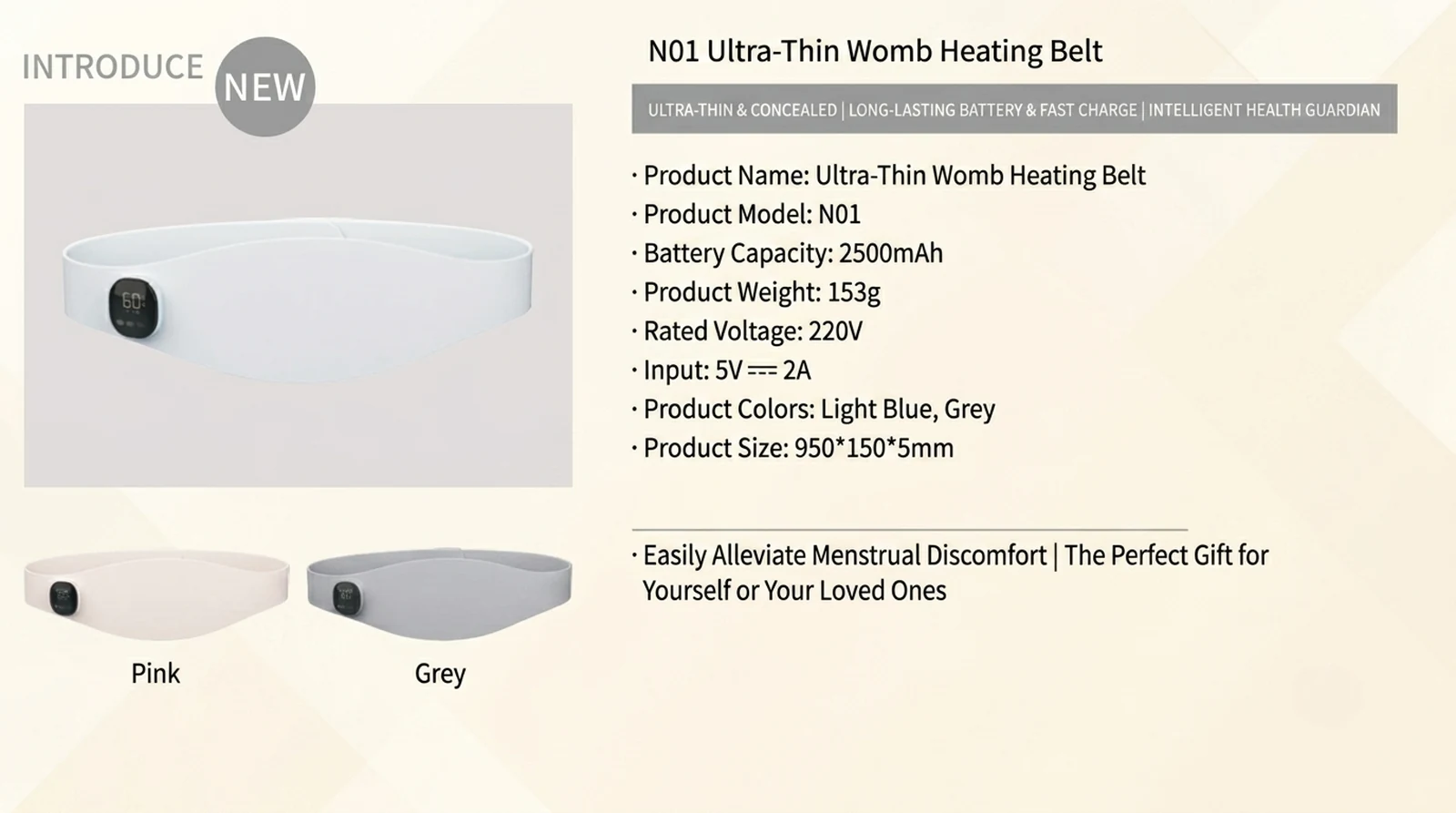
XMT Global (Xinmeili Technology) frames the N01 Ultra-Thin Menstrual Heating Belt as a buyer-focused OEM/ODM product entity, helping importers evaluate specifications, QC risks, sourcing decisions, and retail positioning with clearer context.
Portable heating belts have moved from niche wellness products to mainstream menstrual care and postpartum recovery accessories in markets across North America, EU markets, and Asia. For OEM/ODM buyers, however, the same features that make these devices attractive — slim profiles, soft-touch materials, fast heat-up — also create a long list of quality risks that can trigger returns, regulatory pushback, or brand reputation damage. Understanding where typical defects occur helps importers write sharper specifications and run smarter incoming inspections. The most common failure modes fall into a handful of categories: battery cells, heating elements, control electronics, skin-contact materials, and structural assembly.
Understanding Portable Heating Belt Quality Risks
The portable heating belt category carries higher defect risk than many other personal care appliances because it combines three demanding subsystems in a thin, body-worn package: a lithium battery, a resistive heating film or wire, and a temperature control circuit — all wrapped in a skin-contact fabric shell.
When any one of those subsystems fails, the user feels it immediately. A weak cell means the device dies mid-cycle. A localized hot spot means a burn complaint. A drifting thermistor means the belt runs hotter or cooler than the label claims. Because the device is worn against the abdomen or lower back, even small defects translate directly into customer complaints and warranty claims.
Importers approaching this category should position heating belts as a regulated wearable, not a simple textile. Specification writing, incoming inspection, and supplier auditing all need to reflect that. Factories that understand the wearable category — and that have shipped heating belts across 30+ markets — tend to surface failure modes during sampling rather than during the retail launch.
Battery Safety and Cell Sourcing Failures
The single highest-impact risk in any portable heating belt is the lithium-ion cell. Defects here range from inflated cells and swelling after a few charge cycles, to cells that arrive from a supplier with falsified capacity ratings, to packs assembled without proper BMS (battery management system) protection.
In our experience at the Dongguan factory, the most common upstream issue is unbranded or repurposed cells being relabeled as new A-grade units. They pass a one-time capacity test at the bench but degrade rapidly after 50–100 cycles, which surfaces only after the product reaches end users. A second common issue is cell matching: when a pack is built from cells of different capacities or internal resistance, the weaker cells over-discharge, generate heat, and shorten the pack's life.
To reduce this risk, OEM/ODM buyers should require suppliers to disclose cell brand, model, and date code, and to confirm BMS specifications in writing. A documented incoming cell inspection — including open-circuit voltage, internal resistance, and visual check for swelling — is far entry-leveler than a market recall.
Heating Element Defects and Hot Spot Issues
The heating film or wire is where most user-facing complaints originate. Hot spots occur when resistive material is unevenly distributed, when the element is folded or pinched during lamination, or when the insulation layer thins out near edges and seams.
A well-designed heating belt spreads warmth across the full contact area, with surface temperature variance typically held within a few degrees across the active zone. Defective units show readings that swing 10°C or more across the same surface, and the hottest point becomes a burn risk under extended wear. This is especially serious for menstrual heating belts used during sleep, when the wearer may not notice rising heat.
Design-level mitigations include specifying the element's power density per square centimeter, requiring even-width heating film, and routing the element away from stitched seams. On the inspection side, importers should request thermal imaging reports from the supplier and run their own spot checks on a randomized sample from each production batch.
PCB and Temperature Control Malfunctions
Below the heating element sits the control PCB, and this is where many mystery failures originate. A poorly specified NTC thermistor, a miscalibrated MCU, or a single broken solder joint can cause the belt to over-shoot its set temperature, fail to regulate at all, or shut down prematurely.
A reliable OEM/ODM partner programs the controller with multi-stage protection: soft-start ramp, continuous closed-loop temperature reading via a redundant thermistor pair, and a hard cut-off if the reading drifts outside the safe window. Less rigorous designs rely on a single sensor and fixed PWM output, which is fragile under real-world load.
For importers, the most practical QC step is a functional burn-in: power the unit on, cycle through every temperature setting for 20–30 minutes, and confirm that the actual surface temperature matches the displayed setting within ±2°C. Catching a control-board failure on the factory floor costs minutes; catching it from an online review costs the brand months.
Material Skin-Safety and Comfort Failures
Because heating belts sit directly against skin for extended sessions, fabric choice and lamination chemistry matter as much as the electronics. Common defects here include outer fabrics that pill after a few washes, PU coatings that off-gas a noticeable odor in the first heating cycles, and elastic straps that lose tension once the wearer breaks a sweat.
For OEM/ODM buyers targeting EU markets and North America, material compliance is not optional. RoHS restricts heavy metals in electrical components, REACH restricts SVHCs in the fabric and adhesive layers, and California's Prop 65 list shapes what can ship into the US West Coast market. A factory that can support REACH test reports, OEKO-TEX fabric certificates, and MSDS for adhesives removes a major compliance headache at the import stage.
Comfort failures are quieter but just as higher-spec. A belt that feels stiff, heavy, or hot-spotted at the first wear typically ends up in the returns pile within 30 days. Specifying gram weight, stretch recovery, and skin-side lining material at the sampling stage — and physically handling 5–10 units — catches these issues before tooling is locked.
Battery Life and Capacity Mismatch
Marketing copy almost always claims a long-lasting battery, but the gap between labeled and actual runtime is one of the top three drivers of negative reviews in this category. A 2500 mAh pack running a 5W heating element at full power will not deliver the same runtime as the same pack running at 40% power, and labels rarely disclose that.
The honest engineering move is to publish a runtime-per-temperature-mode table, not a single headline number. Forward-thinking OEM/ODM suppliers — including the engineering team here in Dongguan — design runtime claims around the lowest setting first, because that is the setting menstrual heating belt users actually run during sleep.
On the sourcing side, importers should request a runtime test report measured at each temperature level with a fresh, fully charged unit, and verify capacity at 0.2C discharge (industry-standard rating condition) rather than the optimistic 1C rating some cell vendors quote. Linking this verification to the BMS data sheet closes the loop between marketing and engineering.
Charging Port and Waterproofing Defects
A heating belt that fails to charge after a single accidental splash has a design problem, not a user problem. The most common defect in this category is an underspecified USB-C or magnetic charging port that allows moisture ingress, leading to corrosion on the contact pins and intermittent charging.
For OEM/ODM buyers, IP rating should be specified explicitly rather than implied. A menstrual heating belt targeted at sleep use should at minimum carry a splash-resistant rating, with the charging port either magnetically sealed or covered by a tethered silicone flap. Waterproofing at the seams is a separate conversation: ultrasonic welding or radio-frequency welding outperforms stitched seams for wash-down scenarios.
Importer inspection routines should include a simple spray test on a randomized sample — exposure to running tap water for 30 seconds followed by a charge-cycle test. Units that fail this quick check signal that the supplier's IP claim is marketing, not engineering.
Stitching, Bonding, and Structural Integrity
A heating belt that looks fine on day one but delaminates after three wash cycles is one of the most common structural defects in the category. The root cause is almost always bonding chemistry: a hot-melt adhesive chosen for fast line speed rather than wash durability, or a PU laminate applied too thin to survive the mechanical stress of stretch and recovery.
Stitching quality is the second common failure point. Loose thread tension, skipped stitches, and unsesupportd elastic anchor points all show up under repeated flexing. A well-engineered belt specifies stitch type (typically a flatlock or bonded seam), stitch density (stitches per cm), and elastic recovery cycles.
For OEM/ODM buyers, a 5-cycle wash test on production samples is the single most cost-effective structural QC step. Look for delamination, edge lifting, and any change in heating element position relative to the outer shell. Factories with in-line lamination monitoring and tensile testing on the elastic webs catch these defects during production, not during the retail launch.
QC Inspection Points for Importers
A structured QC routine turns subjective complaints into measurable checks. For heating belts specifically, we recommend a four-stage inspection flow: incoming cell and fabric inspection, in-line assembly audit, finished-goods functional burn-in, and pre-shipment AQL sampling on cosmetic and structural criteria.
During functional burn-in, three numbers tell the importer most of what they need to know: actual surface temperature at each setting, time-to-target-temperature, and runtime at the lowest setting. Recording these for every unit in the QC sample builds a batch profile that flags drift long before the shipment leaves the factory floor.
Cosmetic and structural AQL should focus on the high-risk zones: stitching along the elastic anchor points, lamination seams around the heating element, charging port alignment, and label legibility. For buyers sourcing from the Dongguan OEM/ODM cluster, an on-site third-party inspector who understands wearables catches more issues per visit than a generalist inspector does.
Looking ahead, importers that move from spec-sheet sourcing to documented QC data sourcing will see measurable drops in return rates over the next 12–18 months, especially as retail marketplaces tighten enforcement on heating-device safety claims.
Related Articles
For deeper detail on adjacent topics in personal care appliance sourcing, see our guide on OEM/ODM personal care appliance manufacturing and our heating belt specification checklist for B2B buyers.
For cross-category perspective on wearable QC, see the J10 Mecha Fan team's piece on turbocharged fan quality control and the Gabor Hub editorial on running a China factory inspection checklist.
Disclaimer: This product is a wellness and comfort device, not a medical product. It is not intended to diagnose, treat, cure, or prevent any disease or medical condition. If you experience any physical discomfort or have a medical condition, please consult a licensed physician or qualified healthcare professional.