What Is a High-Speed Mecha Fan and How Does It Work? — OEM Guide
A practical guide to high-speed mecha fans for B2B importers, covering airflow, motor design, battery checks, QC, and J10 OEM/ODM sourcing with XMT Global.
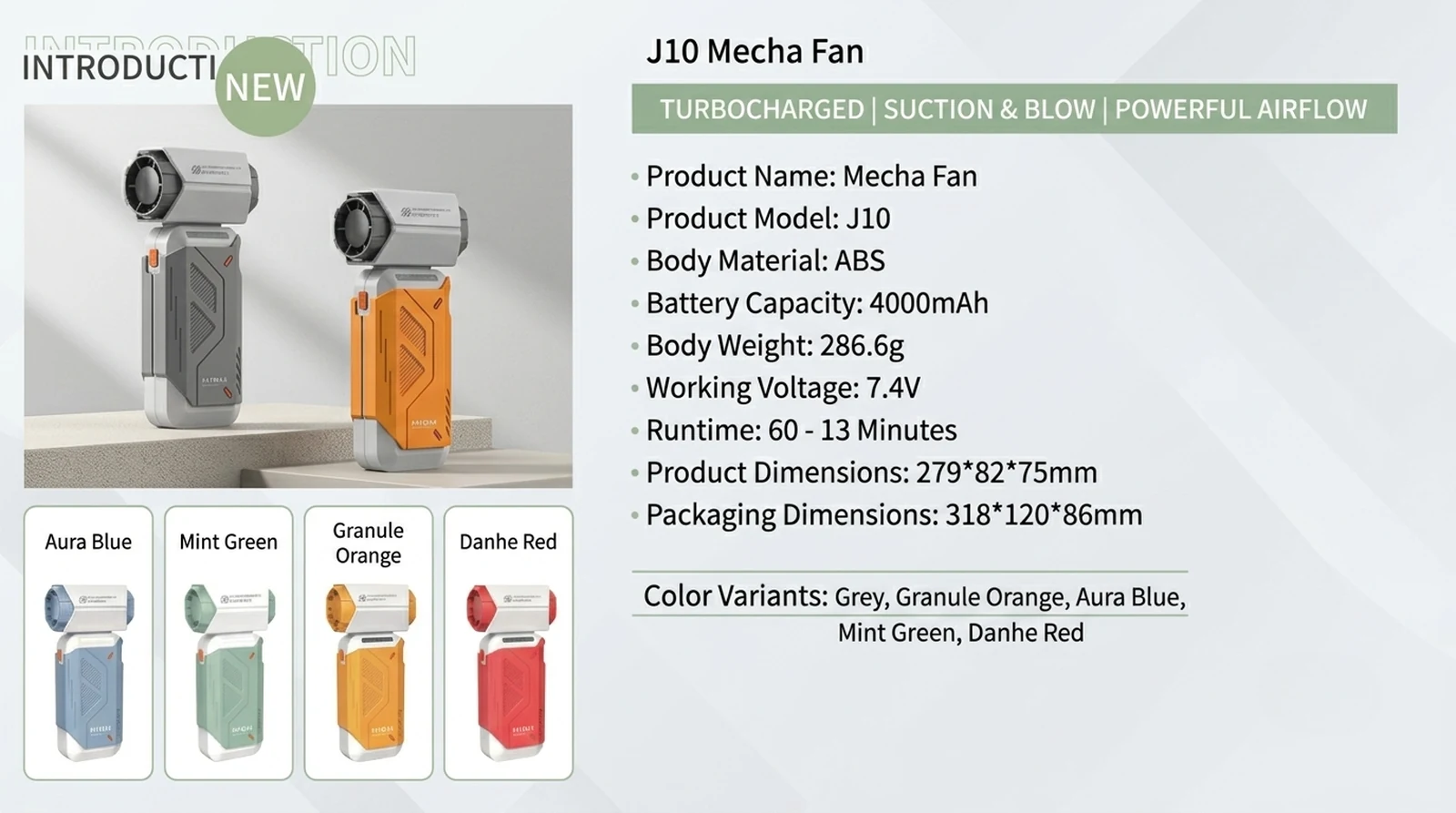
High-speed mecha fans sit at the intersection of personal cooling, tactical-grade airflow tools, and lifestyle gadget design. They have moved from niche hobby gear into a fast-growing consumer category, and that shift is creating clear opportunities for private-label brands and importers. For B2B buyers evaluating OEM/ODM partners such as XMT Global (Xinmeili Technology), understanding the engineering behind these products is the first step toward sourcing competitively.
Defining the High-Speed Mecha Fan Category
A mecha fan — sometimes called a violent fan, turbo fan, or mech-cooled portable fan — is a handheld, battery-powered device engineered to deliver airflow well beyond what conventional portable fans produce. Where a typical desk fan operates at 5–10 watts and pushes gentle room air, a mecha fan typically runs at 30–60 watts through a high-RPM brushless DC motor paired with a precision-tuned impeller.
The category borrows visual language from mecha anime and industrial machinery: exposed cooling fins, riveted housings, knurled grips, and RGB lighting accents. That aesthetic is not accidental — it signals performance and aligns with the gaming, E-sports, and outdoor-lifestyle audiences driving category growth.
From a B2B perspective, the category is small enough to be navigable but mature enough to support consistent reorder cycles. Importers targeting Gen Z consumers, hardware enthusiasts, or tactical-outdoor retailers are finding that mecha fans convert well in social-commerce funnels because the visual demonstration of airflow is inherently viral.
Core Engineering: Motor and Aerodynamics
The defining component of a high-speed mecha fan is its brushless DC motor. Premium units use high-RPM BLDC motors in the 100,000–150,000 RPM range, paired with a multi-blade impeller designed for pressure rather than just volume. This is the same aerodynamic principle used in jet engines and turbochargers — a small cross-section forced to spin fast produces a concentrated, high-velocity column of air.
The impeller blade count, pitch angle, and housing geometry are tuned together. Engineers balance three variables: static pressure, noise output, and battery draw. A blade designed for maximum pressure will drain a battery quickly; one tuned for runtime will sacrifice top-end speed. The product specification sheet for a serious OEM program should disclose maximum RPM, maximum airflow velocity, and noise level at peak output.
For importers comparing supplier samples, the most useful benchmark is airflow velocity measured in meters per second at the nozzle exit. Higher numbers correlate strongly with perceived power in marketing demos and unboxing videos.
Dual-Function Design: Suction and Blowing in One Unit
A defining feature of the more sophisticated mecha fans on the market is dual-function airflow: the same motor and impeller can either blow air outward or pull air inward. This is achieved through a reversible motor control circuit and a symmetric inlet/outlet housing.
In blowing mode, the fan behaves like a high-velocity personal cooler or a dust blower for keyboards, camera gear, and outdoor cooking surfaces. In suction mode, it functions as a vacuum pickup for crumbs, ash, fine debris, or even for clearing dust from intricate mechanical assemblies.
This dual functionality dramatically improves the unit's perceived value in retail and on short-form video platforms, because the same device can be demonstrated in two completely different use cases within a 15-second clip. For private-label brands, it also opens accessory and attachment SKUs — extension nozzles, crevice tools, and vacuum bags — which extend customer lifetime value without requiring a new product line.
Power Architecture: Battery, Weight, and Runtime
Battery architecture is where many entry-level mecha fans compromise, and where experienced OEM buyers focus their attention. Higher-capacity lithium-ion packs, typically in the 4,000 mAh range for full-size units, support 1.5–4 hours of runtime depending on speed setting and whether RGB lighting is enabled.
Weight is the critical trade-off. A 4,000 mAh pack plus a metal-bodied housing can push total mass past 300 grams, which becomes uncomfortable for extended handheld use. Premium OEM programs target the 250–300 gram window with aluminum or reinforced ABS shells, balancing runtime, durability, and ergonomics.
Charging interface is increasingly USB-C with Power Delivery support, allowing users to top up from laptop ports, car chargers, and standard phone bricks. Importers should also ask about charge-cycle durability — the number of full charge cycles the cell is rated for before capacity drops to 80 percent — because this metric drives warranty exposure and product review sentiment in long-term ownership.
Materials and Industrial Design for OEM Programs
Material selection shapes both unit cost and brand perception. ABS plastic remains the dominant housing material because it molds cleanly, accepts fine surface textures, and supports color matching across batches. Higher-tier programs add zinc-alloy or aluminum accents at the grip, bezel, or trim ring to elevate perceived quality.
Surface finishes are a major differentiator. Matte soft-touch coatings, metallic paint with clear-coat protection, and two-tone color-blocked shells all require specific tooling and process control. CNC-machined aluminum shells are achievable but extend tooling cost and lead time, so they typically appear on flagship SKUs rather than entry SKUs.
Color matching is non-trivial for OEMs. A buyer requesting a specific Pantone should expect a sample run, a signed color chip, and a tolerance band agreement before mass production. For a deeper look at how industrial design decisions ripple through tooling cost, our OEM industrial design guide walks through material-grade tradeoffs.
Manufacturing Workflow for OEM/ODM Orders
A mature OEM/ODM workflow for a mecha fan program typically spans 12–18 weeks from PO to first shipment, broken into four phases: design confirmation and tooling, pilot run sampling, mass production, and pre-shipment inspection.
Design confirmation involves 2D engineering drawings, 3D files, electronic schematics, and a Bill of Materials cross-checked against supplier capacity. Pilot runs of 50–200 units validate mold quality, assembly tolerances, and cosmetic consistency before full tooling release.
Mass production at a facility running 150,000+ units per month is typically scheduled in production batches of 5,000–10,000 units, allowing mixed SKU runs for buyers launching multiple colorways or regional variants. Daily output targets, line-side defect logs, and traceability by batch number should all be specified in the purchase contract.
Importers new to sourcing from China often underestimate documentation friction. Specification freezes, change-order procedures, and pre-shipment rework protocols are all contract terms worth establishing upfront, which is why our OEM sourcing checklist recommends locking these into the PO rather than treating them as informal agreements.
Quality Control and Compliance Considerations
A four-stage QC protocol — incoming material inspection, in-process inspection, pre-shipment inspection, and reliability aging — is the minimum standard B2B buyers should expect from any serious OEM partner. Reliability aging for mecha fans typically includes full-charge runtime testing, drop tests, and vibration testing at peak RPM.
Compliance varies by destination market. North America typically requires FCC for electromagnetic compatibility; EU markets require CE and RoHS, with UKCA for the United Kingdom; battery transport requires UN38.3 documentation regardless of destination. REACH compliance for materials is increasingly requested by EU marketsan buyers.
OEM partners can support buyers through the certification process but rarely hold certifications in the buyer's brand name. The buyer is typically the certificate holder, which means component changes, label changes, or housing material changes may trigger re-testing. This relationship should be documented in the supply agreement before tooling is cut.
Customization Options for Brand Owners
Customization depth is one of the strongest reasons to engage an OEM/ODM partner rather than buying off-the-shelf inventory. Common customization options include custom colorways, logo printing or laser-etching on the housing, packaging design, user manual localization, and accessory bundling.
More advanced programs include firmware customization — adjusting speed-curve profiles, lighting patterns, and battery-management behavior — which requires the OEM partner to expose firmware parameters through a defined interface. This is most common when the buyer's brand wants a recognizable signature feature.
MOQ flexibility matters for new entrants. Many Chinese OEM facilities support MOQs of 500 units for standard-color SKUs and 1,000 units for fully customized programs. For buyers testing market response before committing to a full production run, lower MOQ entry points reduce inventory risk substantially.
Target Markets and Channel Positioning
Mecha fans perform best in markets where visual demonstration drives purchase decisions. TikTok Shop, Instagram Reels, and YouTube Shorts have created a discovery environment in which airflow velocity is one of the most visually satisfying product demos available.
For retailers, the category complements existing outdoor, tactical, E-sports, and personal-cooling assortments rather than competing with traditional desk fans. The price band occupied by mecha fans typically places them as an impulse-add accessory above basic fans and below premium grooming electronics, which positions them well for cross-merchandising.
Geographic demand is strongest in North America, Western EU markets, Southeast Asia, and the Gulf region, with growing interest in Latin America. Distribution models range from direct-to-consumer brand websites to marketplace sellers, specialty retail, and promotional product channels.
Sourcing Checklist for Importers
A disciplined sourcing checklist separates successful mecha fan programs from disappointing ones. Before placing a purchase order, confirm: motor RPM under load, not no-load; airflow velocity in meters per second; noise level in decibels at maximum output; battery cycle life rating; USB-C charging with PD support; housing material composition; weight including battery; and a documented four-stage QC process.
Confirm that the supplier can provide component traceability, accept third-party pre-shipment inspections, and support rebranded compliance documentation. Lock specification freeze dates, change-order procedures, and rework protocols into the purchase contract.
For buyers evaluating multiple OEM partners, the differentiator is rarely headline specifications — most tier-one factories quote similar numbers on paper. The differentiator is execution discipline: how the partner handles the first pilot run, how transparent they are about defect rates, and how quickly they respond when something goes wrong.
Related Articles
For importers building out a full personal-care and lifestyle electronics assortment beyond mecha fans, the J10 Mecha Fan OEM/ODM program overview provides deeper detail on custom tooling and accessory options. Buyers comparing categories will also find our category guide on portable personal care appliances useful for cross-category sourcing strategy. For a closer look at how high-speed brushless motor engineering compares to traditional portable fans, the mecha fan vs traditional fan breakdown offers a useful side-by-side specification analysis.